04 Sep,2026
ACL Tear Rehabilitation: A Step-by-Step Guide to Recovery and Return to Sport
An Anterior Cruciate Ligament (ACL) tear is a common knee injury, particularly in sports involving running, jumping, pivoting and sudden changes of direction. Recovery requires a structured rehabilitation program that progressively restores movement, strength, balance, coordination, confidence and sport-specific ability.
The rehabilitation journey is not the same for everyone. The program should be individualised according to whether the ACL injury is being managed conservatively or after ACL reconstruction surgery.
Important: If you have undergone ACL surgery, always follow your surgeon’s specific rehabilitation protocol. Exercise selection and progression should be guided by your physiotherapist.
What Is an ACL Tear?
The ACL is one of the major stabilising ligaments inside the knee. It helps control excessive forward movement and rotation of the shin bone.
An ACL injury can occur due to:
- Sudden changes in direction
- Pivoting with the foot planted
- Awkward landing after jumping
- Sudden stopping or deceleration
- Contact or collision during sport
- Hyperextension of the knee
Common symptoms include pain, swelling, reduced knee movement, difficulty walking and a feeling of instability or the knee “giving way.”
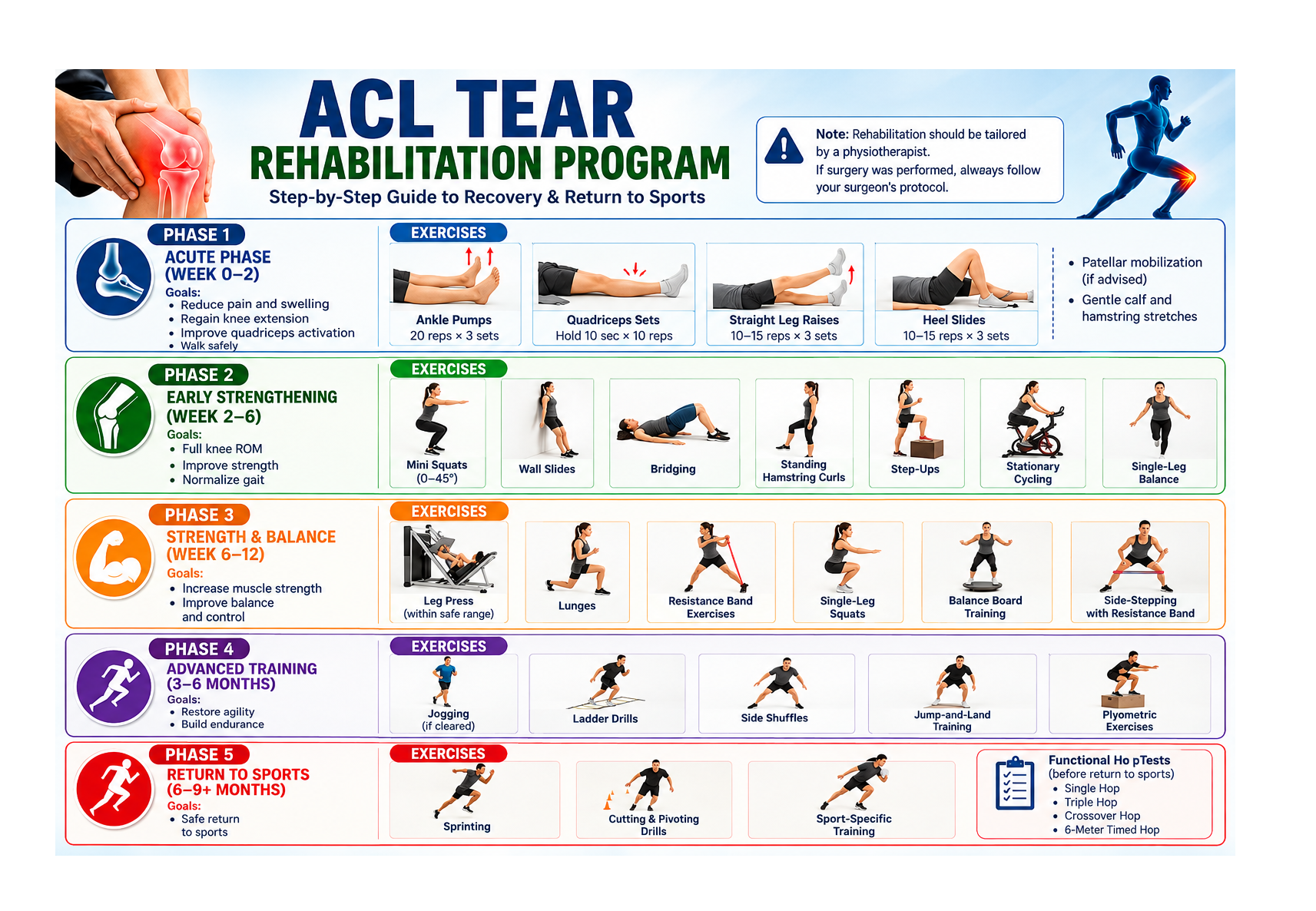
Phase 1: Acute Rehabilitation — Week 0–2
The initial stage focuses on controlling symptoms and restoring basic knee function.
Main goals
- Reduce pain and swelling
- Restore knee extension
- Activate the quadriceps
- Maintain lower-limb circulation
- Begin safe weight-bearing and walking
Common exercises
1. Ankle Pumps
Repeated ankle movement helps maintain mobility and circulation.
2. Quadriceps Sets
Tighten the thigh muscle while keeping the leg straight to encourage quadriceps activation.
3. Straight-Leg Raises
Performed when sufficient quadriceps control is present.
4. Heel Slides
Gently bend and straighten the knee to progressively restore range of motion.
Gentle calf and hamstring stretching and patellar mobilisation may also be incorporated when clinically appropriate.
Phase 2: Early Strengthening — Week 2–6
Once pain and swelling are controlled and knee movement improves, rehabilitation progresses toward strengthening and normalising gait.
Goals
- Achieve functional/full knee range of motion
- Improve lower-limb strength
- Normalise walking
- Improve basic balance and control
Exercises may include
- Mini squats
- Wall slides
- Glute bridges
- Standing hamstring curls
- Step-ups
- Stationary cycling
- Single-leg balance
The intensity should be progressed gradually according to the individual’s symptoms and rehabilitation milestones.
Phase 3: Strength & Balance — Week 6–12
This phase develops the strength and control required for more demanding activities.
Goals
- Increase quadriceps and hamstring strength
- Improve hip and lower-limb strength
- Improve balance and proprioception
- Develop single-leg control
- Prepare for running and higher-level activities
Exercises may include
- Leg Press — within the appropriate range and under professional guidance.
- Lunges — develop functional lower-limb strength and control.
- Resistance-Band Exercises — strengthen the hip and knee musculature.
- Single-Leg Squats — challenge strength and movement control.
- Balance-Board Training — improve proprioception.
- Side-Stepping with Resistance Band — strengthen the hip abductors and improve lateral control.
Phase 4: Advanced Training — 3–6 Months
The focus now shifts from basic rehabilitation toward dynamic movement and athletic performance.
Goals
- Restore strength and power
- Improve agility
- Develop endurance
- Improve running mechanics
- Prepare for jumping and change-of-direction activities
Training may include
- Jogging, when appropriately cleared
- Ladder drills
- Side shuffles
- Jump-and-land training
- Plyometric exercises
Correct landing technique is particularly important. The physiotherapist should assess knee alignment, hip control and trunk position during dynamic activities.
Phase 5: Return to Sport — 6–9+ Months
Returning to sport is the final stage of rehabilitation and should be based on functional readiness rather than time alone.
Goals
- Safely return to sport
- Restore high-level strength and power
- Improve agility and reaction
- Develop sport-specific skills
- Build confidence in the injured knee
Examples of advanced training
- Sprinting
- Cutting and pivoting drills
- Sport-specific training
- Advanced agility and plyometric drills
Training should progressively simulate the demands of the individual’s sport.
Functional Hop Testing
Before returning to high-level sport, a physiotherapist may assess single-leg performance using functional hop tests such as:
- Single hop
- Triple hop
- Crossover hop
- Timed hop tests
These tests can provide useful information about single-leg power, control and side-to-side performance. They should be interpreted alongside strength testing, movement assessment and other return-to-sport criteria.
Why Physiotherapy Is Important After an ACL Tear?
ACL rehabilitation is much more than simply reducing pain.
A comprehensive program aims to restore:
Range of Motion → Strength → Balance → Neuromuscular Control → Running → Agility → Plyometrics → Sport-Specific Performance
Physiotherapy can help monitor progress and determine when it is appropriate to progress from one stage to the next.
When Should You Seek Professional Assessment?
If you experience a significant knee injury accompanied by:
- A popping sensation
- Rapid swelling
- Difficulty bearing weight
- Loss of knee movement
- Recurrent giving-way episodes
- Persistent pain or swelling
- Locking or catching
you should seek assessment from an appropriately qualified healthcare professional.
Key Takeaway
An ACL tear can be a significant injury, but structured and progressive rehabilitation can help restore knee function and prepare an individual for a safe return to everyday activities, exercise and sport.
The ACL rehabilitation journey:
Acute recovery
↓
Restore movement
↓
Build strength
↓
Improve balance & control
↓
Running & agility
↓
Plyometric training
↓
Sport-specific training
↓
RETURN TO SPORT
Every ACL injury is different. A personalised rehabilitation program developed by your physiotherapist and medical team is essential for safe and effective recovery.
This article is for general educational purposes and does not replace an individual assessment or treatment plan from a physiotherapist, sports physician or orthopaedic specialist.